
Jonathan Edwards

To celebrate TR’s Vice Presidential victory November 6th, 1900 a group of West Virginia supporters sent a small black bear cub to Roosevelt as a gift for his children. The kids named the bear Jonathan Edwards and it stayed at Sagamore Hill over the Christmas season from November 1900 to January 1901.
Jonathan Edwards never made it to the White House. The cub was sent to the Bronx Zoo before TR had been sworn in as President, September 14, 1901.
In a November 22, 1900 letter sent from Sagamore Hill to journalist Edward Stanford Martin TR wrote, “Some of my Republican supporters in West Virginia have just sent me a small bear which the children of their own accord christened Jonathan Edwards, partly out of compliment to their mother’s ancestor, and partly because they thought they detected Calvinistic traits in the bear’s character.”

In the Outdoor Pastimes of an American Hunter Roosevelt wrote, “as the bear grew, so did his temper and wildness.” Roosevelt concluded Jonathan Edwards was not making a good addition to the Roosevelt family and admitted it was time for him to go. TR said the only members of the household who may have been sorry to see him leave were the dogs, since “he had occasionally yielded them the pleasure of the chase in its strongest form.”
On January 2, 1901 TR dictated a note to his friend William Hornaday who had served as the Chief Taxidermist for the Smithsonian and had become the First Director of the Bronx Zoo asking if the zoo would be interested in giving Jonathan Edwards a home? Hornaday, a member of Roosevelt's Boone and Crockett Club said yes and the bear was on it’s way from Oyster Bay to the Bronx. TR wrote, “it was a great relief to see him go.”

According to the Bronx Zoo Jonathan Edwards was an ill tempered bear with a cranky disposition. He often terrorized the zoo’s younger cubs. In the years that followed Jonathan Edwards sired a prodigious number of offspring that were shipped to zoos all across the country.
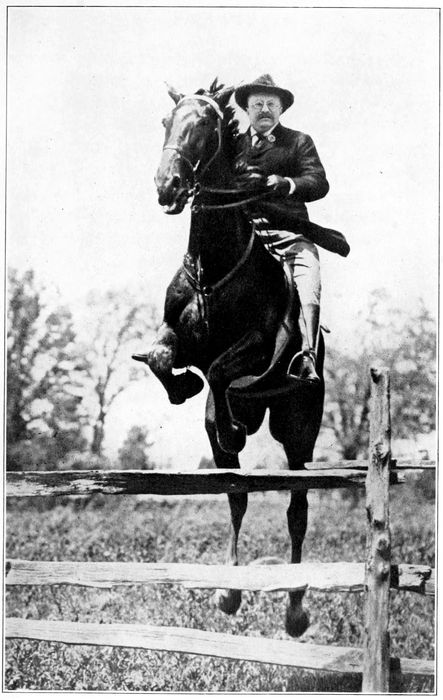
While in the White House the Roosevelt’s adopted over 40 presidential pets. It was the largest collection to ever occupy 1600 Pennsylvania Avenue. TR’s favorite were the horses. In the Outdoor Pastimes of an American Hunter, he wrote, “Of course there are no pets like horses and horsemanship is a test of prowess. The best among vigorous out-of-door sports should be more than pastimes.
Play is good for play’s sake, within moderate limits, especially if it is athletic play; and, again within moderate limits, it is good because a healthy body helps toward healthiness of mind. But if play serves only either of these ends, it does not deserve the serious consideration which rightly attaches to play which in itself fits a man to do things worth doing; and there exists no creature much more contemptible than a man past his first youth who leads a life devoted to mere sport, without thought of the serious work of life.
In a free Government the average citizen should be able to do his duty in war as well as in peace; otherwise he falls short. Cavalrymen and infantrymen, who do not need special technical knowledge, are easily developed out of men who are already soldiers in the rough, that is, who, in addition to the essential qualities of manliness and character, the qualities of resolution, daring and intelligence, which go to make up the “fighting edge,” also possess physical hardihood; who can live in the open, walk long distances, ride, shoot, and endure fatigue, hardship, and exposure. But if all these traits must be painfully acquired, then it takes a long time indeed before the man can be turned into a good soldier. Now, there is little tendency to develop these traits in our highly complex, rather over-civilized, modern industrial life, and therefore the sports which produce them serve a useful purpose. Hence, when able to afford a horse, or to practice on a rifle range, one can feel that the enjoyment is warranted by what may be called considerations of national ethics."
