
Social Media
Today social media has become a major driver of political temperament in the U.S. Three Presidents, we all know by their initials, JFK, FDR and TR all used the latest in social media to help deliver their presidency.
Until Roosevelt America had never seen their president on horseback jumping a fence, or posing in front of the Grand Canyon. or sitting at the controls of a big rig at the Panama Canal. He became bigger than life, bigger than the presidency.

Theodore Roosevelt was perhaps the one president who gained the most from social media. He mastered use of the newspapers, cartoons and gave us some of the best catch phrases in American history. He called opponents “fatheads, puzzle wits and pin-heads.” He had his own logo of eyeglasses, mustache and teeth. Every meal was a “banquet” and when it was fun it was “Bully.” The iconic Teddy Bear was stitched in his honor. Imagine how much a politician would pay today to have the most popular toy in America serve as their sidekick; a daily reminder of your adventures, achievements and successes. TR became a beloved member of the family. There were kids who wouldn't go anywhere without their Teddy Bear. At the end of the day children across the country getting ready for bed turned to their Teddy Bear for comfort and security in the same way the nation turned to Roosevelt for its safety and protection TR’s media success reached worldwide recognition. In France they said there were two amazing things in the United States. One was Niagara Falls and the other was Theodore Roosevelt.
TR’s 5th Cousin Franklin DeLano Roosevelt brought in a new era when he used radio to create his fireside chats. Now your voice and the way you said things became as important as the words you used.
John F. Kennedy used television to change the way America wanted to receive the news and view current events. Print took a backseat to image. It now became important in how you looked on a small screen. When JFK was assassinated America tuned to Walter Cronkite to not only give us the latest news, but to talk to us and to help us get through the tragedy. Some saw Jack Ruby kill Lee Harvey Oswald live as it happened. Television brought America to Arlington for the burial and the lighting of the Eternal Flame. For most Americans it was from that point forward that television replaced the printed word. It was better to see things live then to read about them a day later.

Before Cellphones, TV and Radio America got its news in print. Newspapers were a fast growing business. In the 1830s there were about 900 newspapers published in the U.S. Ten years later it grew to 1,631 and by 1850 it was up to 2,526. Annual circulation was half a billion serving just under 23 million readers.
Newspapers became big business with big printing plants and scores of employees. Washington decided to subsidize the newspaper business. Papers weren't taxed. They received preferential postage. Publishers were allowed to exchange their papers with other publishers without postage giving small newspapers free access to the stories be covered by larger papers who could afford to hire more reporters.
The expansion of the railroads along with the inventions of machine-made paper, new steam-driven printing presses and the telegraph all created an entirely new revolution in communication.

The telegraph made instant long-distance communication possible and that changed politics. In 45 minutes newspapers knew exactly what was going on in Washington. The ability to report votes in near real-time allowed citizens to know the results soon as they were announced. In 1850 Representative Joseph Root of Ohio noted the telegraph allowed rural newspapers to compete with city papers because they both received the news at the same time.

The newspaper business began to explode. In 1810 Indiana had only 1 newspaper, by 1870 there were 73. America wanted to know what was going on and they relied on newspapers to keep them current. Political parties and candidates began to use newspapers to promote their ideas and platforms. Businesses began to rely on newspaper advertising to reach their customers and stay ahead of the competition. Over the decades that followed urban cities were able to support multiple daily’s. On every corner you could hear newspaper boys, “extra…extra….read all about it….!” America was hungry to get the scoop and dig into the gossip.

Before the 1880s newspapers couldn't print photos. Instead artists sketched images and engravers carved them into woodblocks. In 1880, the year TR married Alice, New York's Daily Graphic was the first paper to use a screen-based reproduction system that allowed photographic images to be printed alongside text. Now readers could see the tornado. The problem was tornadoes didn’t show up every day, but every day you could take pictures of President Roosevelt and the first family. TR and his family began to sell papers. Unlike other politicians who saw talk as action. TR showed America what action was really all about. In the White House he gave reporters their own press room.
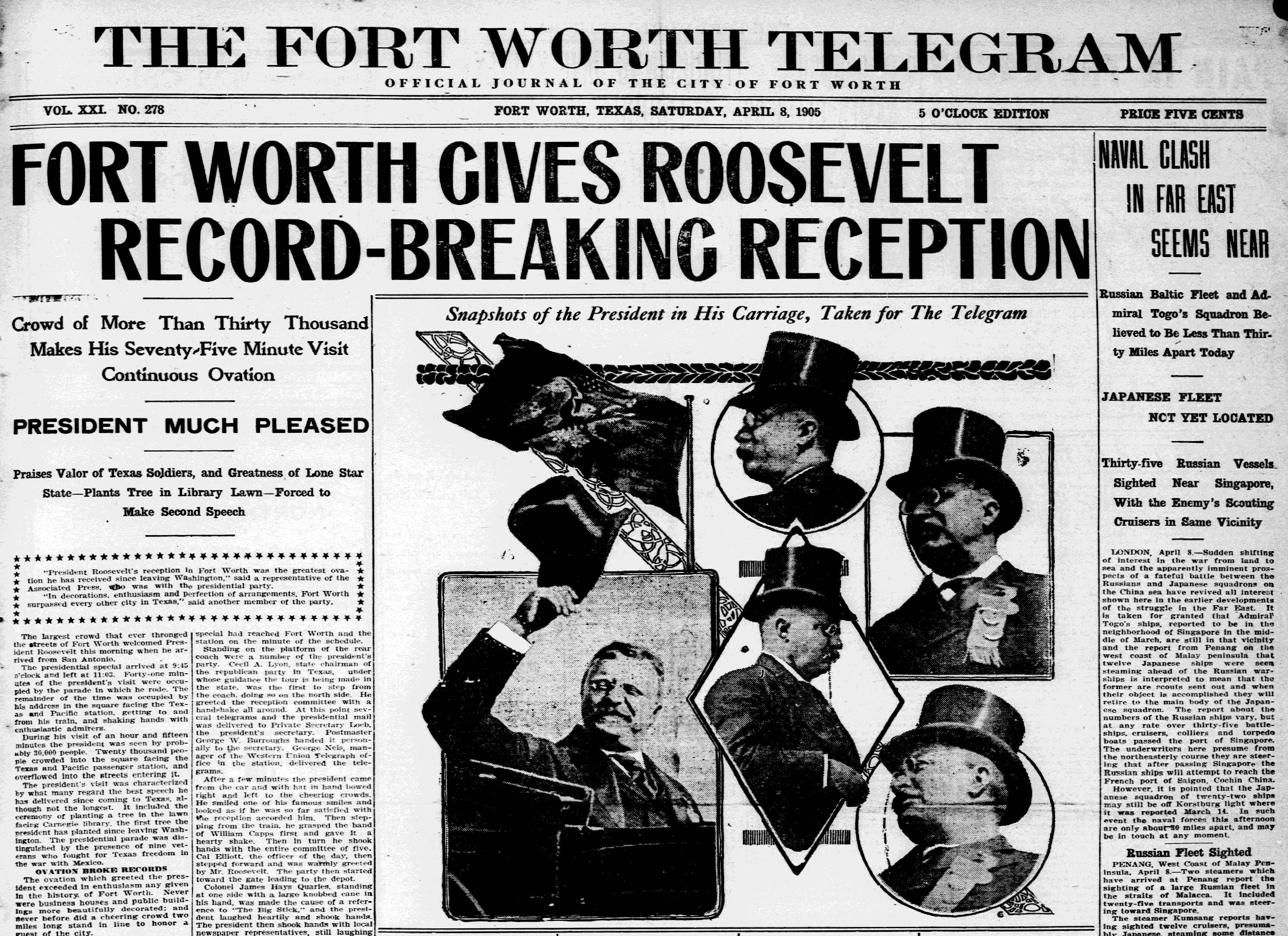
By the early 1900s the New York Times began to regularly use photography on their front page.
Cartoons helped shape opinion and comic strips helped entertain America young and old. Debuting in 1895 Mickey Dugan, The Yellow Kid, is considered the first comic strip character. He appeared in the New York World. The Yellow Kid was a barefoot, bucktoothed, big eared, bald headed kid living in New York City.

He was the creation of Richard Outcault and first appeared in Truth Magazine in1894, A year later the Yellow Kid moved to Pulitzer's New York World. This was at a time before cartoonists drew balloons for dialogue. Instead the dialogue was written on the kids Yellow shirt.
In the newspaper war between Pulitzer and Hearst the “Yellow Kid ” led to "Yellow Journalism.” In this cartoon Pulitzer and Hearst are dressed like the Yellow Kid, barefoot, big eared and arguing over what became the Spanish American War. Hearst is threatening Pulitzer and tells him this is “his war that he bought and paid for." Hearst sent Frederic Remington to Cuba to see what he could find and when Remington said he found nothing Hearst told him to look harder and find something. “You provide the pictures….I'll provide the war.” During their presidentcys TR, FDR and JFK all understood the importance in using social media in their effort to forge public opinion.

