
Visiting Sagamore Hill 1904 - 1905
Early view of Cove Neck Road.

Original entrance without gate or fence.

Sagamore Hill is a Queen Anne style shingled home designed by architects Lamb and Rich. It was built between March 1884 and May 1885 by John A. Wood and Son of Lawrence, Long Island.
The 95 acre property was $20,000. The house cost $16,975 to build and included the windmill and ice house. A Lodge and Stable was added for $5,160 bringing the total cost to $42,135. ($1,400,000 Today).

This may be the earliest surviving photograph of the Roosevelt's view overlooking Oyster Bay. It was found in one of Edith's photo albums. On the back Edith wrote, “Taken years ago before the trees grew up to hide the view.”

In 1905 TR added the North Room for $19,000. It was designed by Christopher Grant LaFarge who designed many of the original IRT stations including the historic City Hall Station. The NYC subway opened on TR’s birthday in 1904. (TR was invited, but declined) LaFarge also designed the administrative buildings, Astor Court, the Lion, Monkey, Bird and Elephant houses at the New York Zoological Park; the Bronx Zoo. He was a favorite of the Roosevelts.
In this early photograph of the North Room it shows TR hung Pinckney Marcius Simons’ painting "Victory" over the fireplace before the larger “When Light Meets Shadow.” On the mantle is the Rough Rider bronze done by Frederick MacMonnies in 1904.
When you include the North Room and all the out buildings; Grey Cottage, Gardeners Shed, the Chicken Coop, Tool Shed, Tennis Court and the new 1907 Barn, TR spent somewhere between $65,000 and $70,000. (That’s about $2.5 to $2.6 million today).
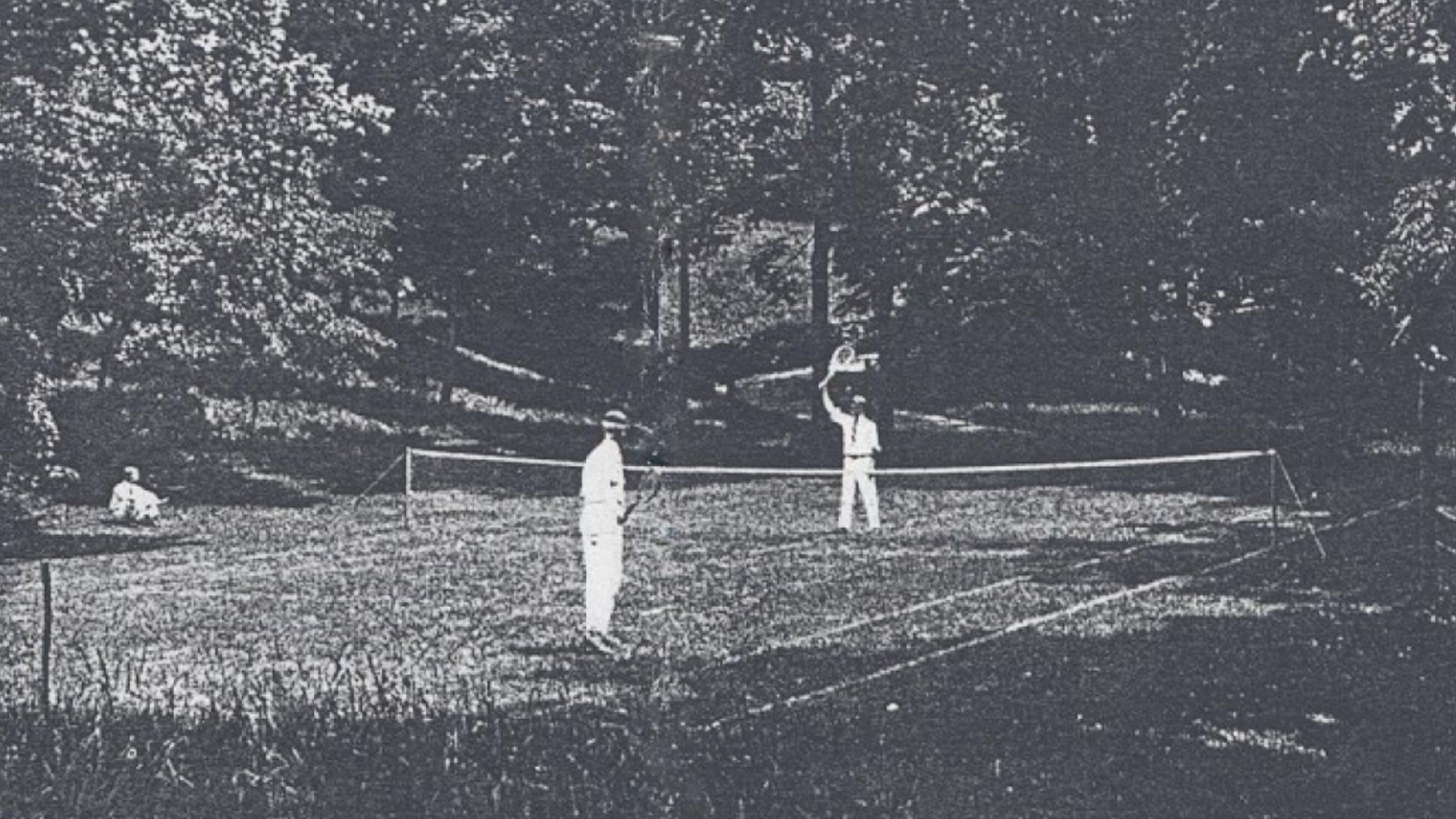
A grass tennis court was down the slope about 100 yards from the front door.

Theodore Roosevelt turned Oyster Bay into the country’s summer Capital. In 1903, after having outgrown the Oyster Bay Bank, TR moved his office to the 2nd Floor of the Moore Building.
On the evening of July 4th, 1903 TR transmitted the first "Around the World" cable sent from the library at Sagamore Hill to the Moore Building and then around the world. The message was sent at 11:23. The return was received by Clarence McKay, owner of the Atlantic Cable Company, at 11:35.
There's some disagreement to how long it took. Its often reported it took 9 minutes 30 seconds to go around the world, but if McKay’s claim is correct that the cable left Oyster Bay at 11:23 and returned at 11:35 that meant it took 12 minutes.
The summer office was managed by TR’s Secretary William Loeb. It was Loeb who met TR at North Creek and delivered John Hay’s telegram that McKinley had died. Loeb would go on to become the nation's first unofficial Presidential Press Secretary.
The road leading out of town is East Main Street. It turns into Cove Road and would take you past Tranquility. If you continue south you run into Cove Neck Road that would take you to Sagamore Hill.

Many of the press, political figures, celebrities and vacationers frequently stayed at the Octagon Hotel. The building became an Oyster Bay landmark.
Over the years the hotel took on a number of different names. It was initially called the Nassau House when it was built in 1851. By 1870 the name had changed to the Acker Nassau House named for its new owner. Henry Acker was eventually run out of town after taking a pistol and shooting his wife. She recovered and went on to buy the East Norwich Hotel. After that the name changed to simply the Octagon Hotel. After the turn of the 20th Century it would become the Davenport Octagon Hotel.
During it's heyday it was a popular restaurant and political hangout with a bar and pool table. In 1899 while governor TR maintained a one-room office on the second floor. The space soon became too small and he moved the staff to larger offices in the Oyster Bay Bank and then to the Moore Building during his presidency.
Octagon shaped construction became a popular trend in the 19th Century. The craze peaked in the 1850s and early 1860s when it promised improved sunlight, better ventilation and more economic construction.
The Octagon Hotel and the Sagamore Hill ice house are the only surviving octagon shaped structures in Nassau County. In Suffolk County there are several surviving examples including an octagon shaped house in Huntington.
