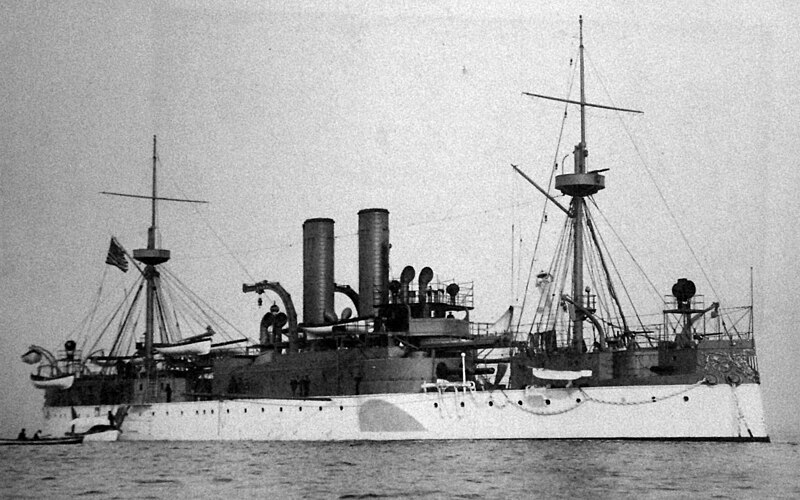
Sinking of the Maine
On February 15th, 1898 the Maine was to head for New Orleans in time for Mardi Gras. By then, McKinley hoped, anti-Spain fervor should have died down. but at 9:40 a massive explosion tore through the ship, killing 250 men and two officers. (Mortal injuries would eventually total 266.)
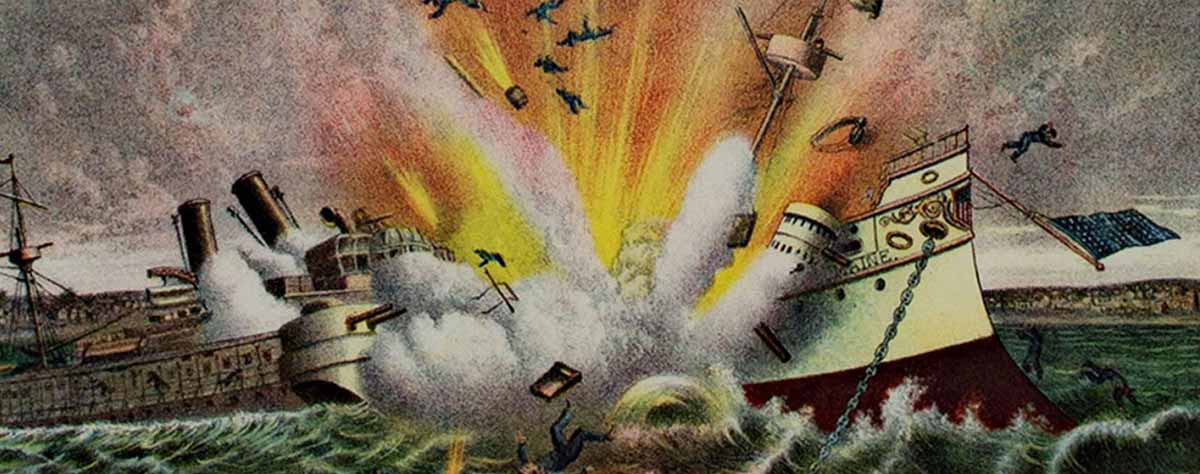
A Court of Inquiry questioned survivors—including commanding officer Captain Charles D. Sigsbee—and interpreted the reports of divers. The theory that a mine had destroyed the ship stemmed primarily from eyewitness testimony. The report of diver W. H. F. Schluter was particularly significant. He said he could see green paint on a bottom plate that was "all torn ragged and it looked to be inward." Bottom plates on the outside were painted with antifouling green paint. So, this produced the image of a plate being blasted from the outside and turned inward.
The question lingered until 1911, after the U.S. Corps of Engineers, in an unprecedented feat, built a cofferdam around the ship, pumped out the water, and exposed the wreckage. A Board of Inquiry based much of its analysis on photographs of physical evidence that the previous investigation had sensed but not seen bottom plates that were bent inward, presumably by an external force, such as a mine. The board focused on a section of outside plating that "was displaced inward and aft and crumpled in numerous folds."
Although the 1911 report placed the location of the explosion farther aft, the 1911 inquiry's conclusion agreed with that of 1898: "The board believes that the condition of the wreckage . . . can be accounted for by the action of gases of low explosives such as the black and brown powders with which the forward magazine were stored. The protective deck and hull of the ship formed a closed chamber in which the gases were generated and partially expanded before rupture."
The question disappeared. Historians writing after 1911 took for granted that someone—Spanish sympathizers, perhaps, or disgruntled guerrillas hoping to goad the United States into war—had set a mine that blew up the Maine.
After reading a newspaper story in 1974 about the sinking of the Maine, Admiral Hyman G. Rickover decided to reexamine the issue. He recruited historians, archivists, and two Navy experts on ship design: Robert S. Price, a research physicist at the Naval Surface Weapons Center at White Oak, Maryland, and S. Hansen, assistant for design applications in the Structures Department at the David W. Taylor Naval Ship Research and Development Center at Cabin John, Maryland. Among Price's Navy projects had been an analysis of the wreckage of the nuclear-propelled submarine Scorpion (SSN-589), which was lost in May 1968.
The Hansen-Price analysis, as Rickover called it, was the heart of a short book published in 1976. The 23-page analysis reached this conclusion: "We found no technical evidence . . . that an external explosion initiated the destruction of the Maine. The available evidence is consistent with an internal explosion alone. We therefore conclude that an internal source was the cause of the explosion. The most likely source was heat from a fire in a coal bunker adjacent to the 6-inch reserve magazine. However, since there is no way of proving this, other internal causes cannot be eliminated as possibilities."
Again, historians rallied around the Rickover solution, and after 1976 most discussions of the Spanish-American War concluded that there was no mine.

As the 100th anniversary of the sinking of the Maine approached, David W. Wooddell, senior researcher on the editorial planning council of National Geographic magazine, suggested that the magazine commission an analysis of the disaster based on computer modeling not available to Rickover and his team. Advanced Marine Enterprises (AME), a marine engineering firm often used by the U.S. Navy, accepted the mission.
The AME analysis, which was announced in the February 1998 issue of National Geographic, examined both the mine and the coal bunker theories. The report declared that "it appears more probable, than was previously concluded, that a mine caused the inward bent bottom structure and detonation of the magazines."