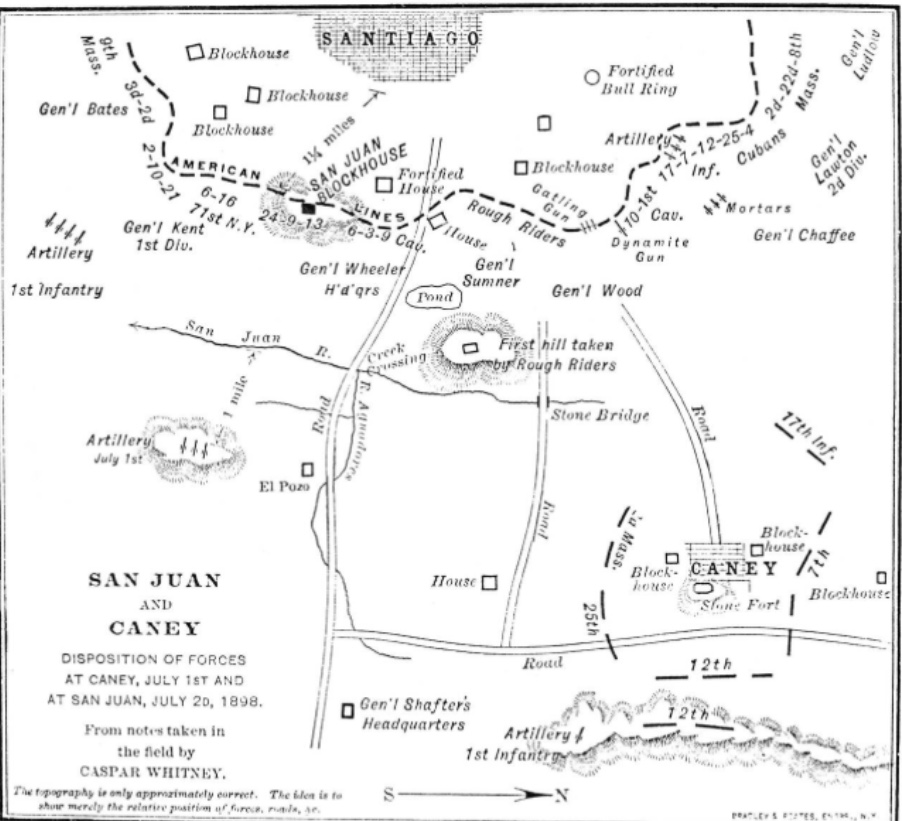
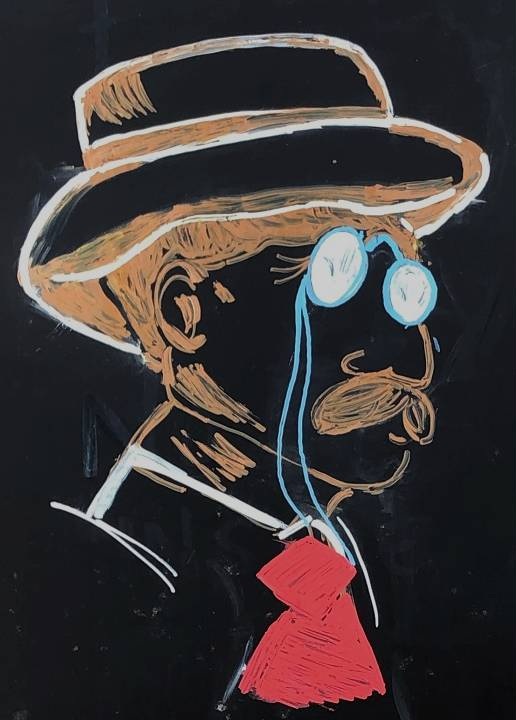
TR Shoots a Spaniard Critics View
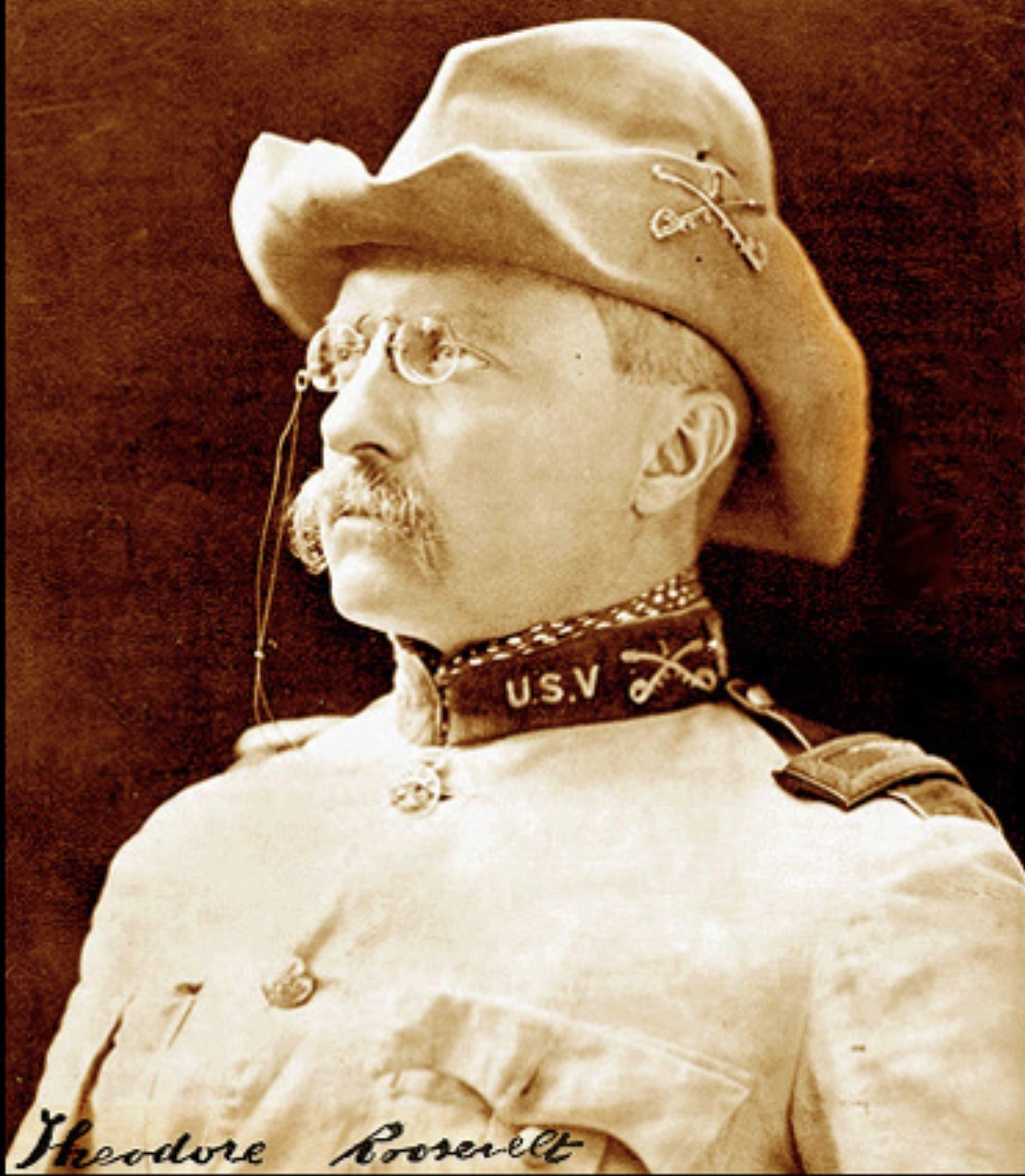
Roosevelt wrote, I had intended to go into action on foot as at Las Guasimas, but the heat was so oppressive that I found I should be quite unable to run up and down the line and superintend matters unless I was mounted; and, moreover, when on horseback, I could see the men better and they could see me better.
Newspapers, illustrators and social historians led to the image of Roosevelt on horseback leading the regiment in a headlong charge up the San Juan Heights. It helped to forge the character of Roosevelt and to this day captures the American imagination of Roosevelt the citizen shoulder showing no fear in the face of the enemy.
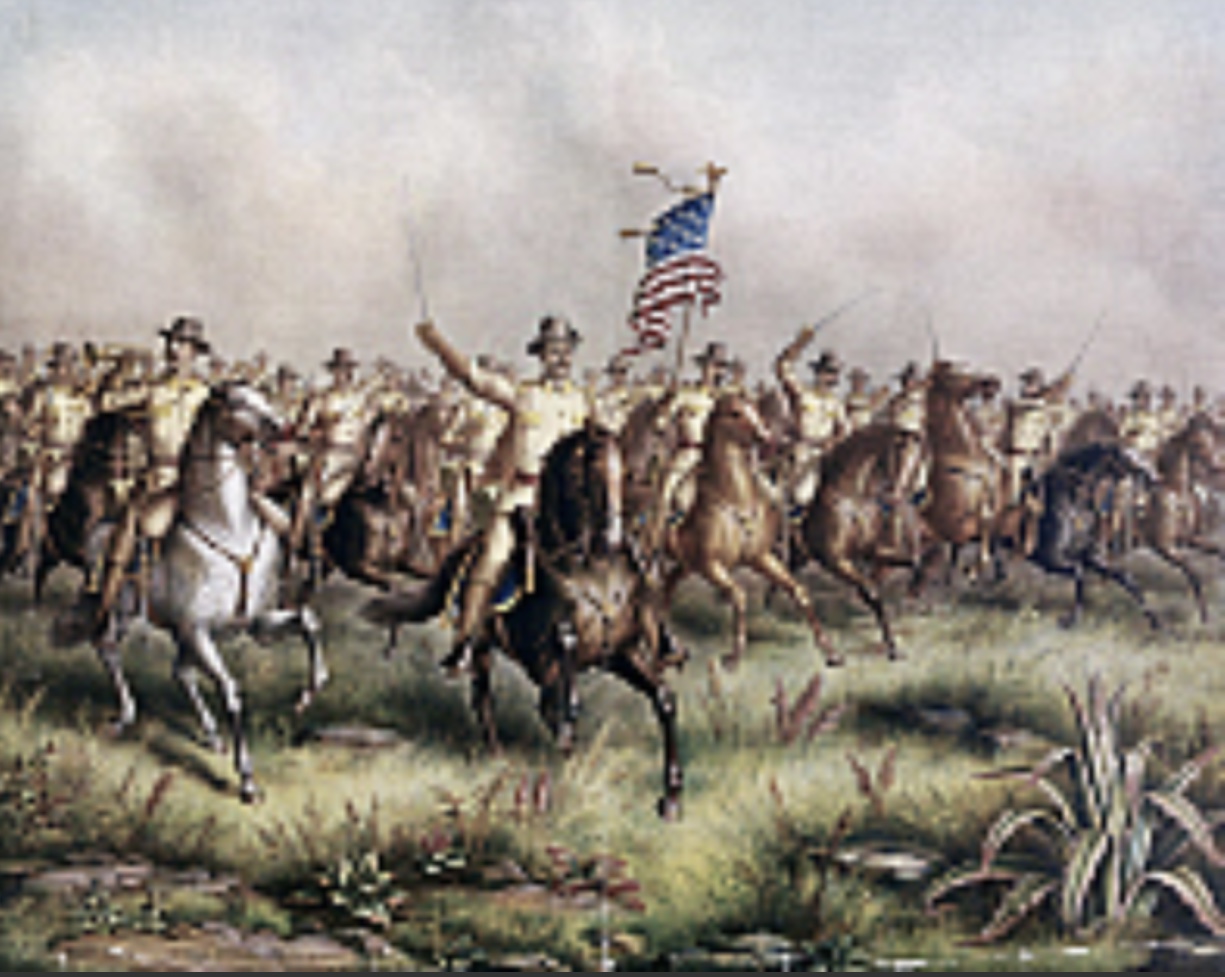
The truth was far from the grade school textbooks. The lack of transport space forced the Rough Riders to leave their horses in Tampa. They attacked on foot. Roosevelt was an officer and got to bring two horses with him on the Yucatan. Rain in the Face drowned during the landing, but Little Texas made it to shore.
Roosevelt wrote, When Bucky O’Neill was shot his troop, who were devoted to him, were for the moment at a loss whom to follow. One of their number, Henry Bardshar, a huge Arizona miner, immediately attached himself to me as my orderly, and from that moment he was closer to me, not only in the fight but throughout the rest of the campaign, than an other man.
Sgt. Ousler fighting in the Regular Army remembered seeing Roosevelt during the charge He wrote he saw Roosevelt “some distance ahead of the line during the whole scrap, moving up and down with a word here and there to the company and troop commanders.”
Roosevelt wrote that some 40 yards from the top I ran into a wire fence and jumped off Little Texas, turning him loose. He had been scraped by a couple of bullets, one nicked my elbow, and I never expected to see him again.
I ran up to the hill when Bardshar stopped to shoot, and two Spaniards fell as he emptied his magazine.
Running up the hill at the double two Spaniards leaped from the trenches and fired at us, not ten yards away. As they turned to run I closed in and fired twice, missing the first and killing the second.
Two things critics of the account always site is how did Roosevelt get to within 10 yards of a fortified trench in open ground without being noticed. The trenches were built with a clear view of the approach and no defender should have been surprised.
The other is If for some unexplained reason the Spanish let the attack get to within 10 yards of their trenches without retreating to the safety of their own defensive perimeter rather than jumping up into enemy fire at close quarters.
Roosevelt only carried his sidearm into the assault against entrenched positions supported by artillery and machine gun fire.
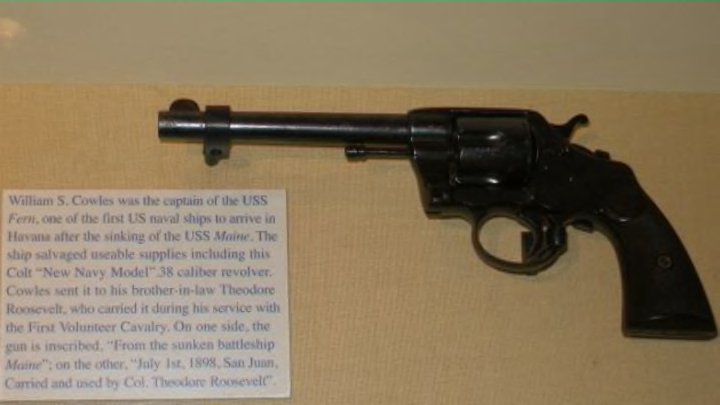
TR wrote my revolver was from the sunken battleship Maine and had been given me by my brother-in-law, Captain W. S. Cowles, of the Navy. The military considered officer’s sidearms as a last line of personal defense.
Roosevelt's Colt was a 38 caliber Model 1892 Army and Navy revolver. It was no match against the Model 1893 German Mauser issued to the Spanish troops. The Mauser was the most accurate infantry weapon in the battle with an effective range of 2,187 yards compared to the Colt's 25 yards.
Taking into account Rosevelt’s poor eyesight and then deficiencies of the Colt’s ammunition and rudimentary sites TR reacted brilliantly in the fog of war managing to get off a fatal shot downing a moving target in the jungle heat of Cuba in July.
After the war Henry Bardshar served as a Collector for the Internal Revenue in Arizona, New Mexico and Alaska under Roosevelt and Taft.
It’s interesting Henry Peck Bardshar doesn’t appear on the 1st Volunteer Cavalry Rough Rider Roster. Perhaps it’s a regimental error or perhaps he joined or transferred to the regiment in Tampa or Cuba. Bob Wren only got to Cuba because TR gave him his personal Winchester 95. You couldn’t go to Cuba if you didn’t have a firearm.
The following is a list of all the Rough Riders who had a last name that started with the letter “B.” Its in alphabetical order and Bardshar's name doesn’t appear on the list.
Babcock, Campbell E. – Troop K
Babcock, Guy M. – Troop L - Saddler
Baca, Jose M. – Troop E
Bailey, Robert Z. – Troop F
Bailey, William – Troop D
Bailie, Harry C. – Troop I
Bainter, Abraham L. – Troop I
Baird, Thompson M. – Troop M
Baker, Philip S – Troop H
Ballard, Charles L. – Troop M – 2nd Lt.
Barlow, John W. – Troop M
Barnard, John C. – Troop A
Barney, Leland – Troop M
Barrington, John P. – Troop M
Barthell, Peter K. – Troop C
Bartoo, Nelson E. – Troop A
Bassage, Albert C. – Troop I
Batchelder, Wallace N. – Troop K
Bates, William H., - Troop I
Bawcom, Joseph L. – Troop F
Beal, Andy R. – Troop M
Beal, Fred N. – Troop D
Beard, Lyman F. – Troop D – Cpl.
Beard, William M. – Troop E
Beck, Joseph H. – Troop E
Beebe, Walter S. – Troop B
Beissel, John J. – Troop G
Belknap, Prescott H. – Troop A
Bell, Dillwyn M. – Troop L – Sgt.
Bell, John H. – Troop F - Trumpeter
Bell, Sherman – Troop K
Bell, William A. – Troop F
Bendy, Cecil C. – Troop H
Bennett, Edward – Troop E
Bennett, Horton A. – Troop H -Wagoner
Benson, Victor H. – Troop L
Bernard, William C. – Troop K
Berner, Harry E. – Troop M – 1st Sgt.
Bird, Marshall N. –Troop B
Bishop, Louis B. – Troop G
Black, Columbus L. – Troop H
Black, James S. – Troop F
Boan, James F. – Troop F – Cpl.
Boehnke, John – Troop F – Cpl.
Bogardus, Frank – Troop F
Boggs, Looney L. – Troop B
Bohlinger, Eugene – Troop F - Sgt.
Booth, Frank B. – Troop F
Borrowe, Beekman K. – Troop B
Borrowe, Hallett Alsop – Troop I
Boschen, John – Troop I
Bowler, George P. – Troop C
Boydstun, John F. – Troop M
Boyle, James S. – Troop A
Bradley, Peter – Troop C
Bradley, Thomas G. – Troop K - Farrier
Bradshaw, Henry P. – Troop A
Brady, Fred L. – Troop B
Brady, James B. – Hospital Corps - Steward
Brierty, Thomas – Troop M
Brandon, Perry H. – Troop K
Brauer, Lee W. – Troop A
Brazelton, William H. – Troop G
Breen, Timothy – Troop E – Sgt.
Breen, William J. – Troop K – Cpl.
Brennan, Jeremiah – Troop F
Brennan, John M. – Troop F
Briggs, Frank – Troop G – Cpl.
Brito, Frank C. – Troop H
Brito, Jose – Troop H
Brodie, Alexander Oswald – Lt. Col.
Brown, Edwin M. – Troop G
Brown, Harry R. – Troop I
Brown, Henry A. – Chaplain
Brown, Hiram T. – Troop E
Brown, James – Troop G – Sgt.
Brown, James T. – Troop D – Trumpeter
Brown, John, Troop I and Troop G
Brown, Leon – Troop M
Brown, Percy – Troop H
Brown, Robert – Troop G
Brown, Robert - Co A – Sgt.
Bruce, Peter R. – Troop M – Wagoner
Bruce, Robert H. – Troop M – Capt.
Brumley, William H., Jr. – Troop G
Brush, Charles A – Troop I
Bryan, John B. – Troop H
Buckholdt, Charles – Troop B
Bucklin, Elhanan W. – Troop H – 1st Sgt.
Bugbee, Fred W. – Troop A
Bugbee, George L. – Troop A – Cpl.
Bull, Charles C. – Troop A
Bull Henry W. – Troop K – Cpl.
Bullard, John W. – Troop H
Bullock, Seth – Troop A - Capt.
Bulzing, William – Troop A
Bump, Arthur L. – Troop E and Troop K
Burden, I. – Troop K
Burdswell, Lee – Troop K – Wagoner
Burgess, George W. – Troop D
Burke, Edward F. – Troop D
Burks, Jesse E. – Troop M
Burks, Robert E. – Troop C
Burris, Walter C. – Troop F
Butler, James A. – Troop B
Butler, Peter L. – Troop M
Byan, John B – Troop H
Byrd, Samuel J. W. – Troop M
Byrne, John – Troop F and Troop L
Byrne, Peter F. – Troop D
Byrnes, Orlando C – Troop C
While he doesn’t appear on the rooster Bradshar claimed he typed Roosevelt’s Round Robin letter. He said he also convinced Roosevelt the language was too harsh and sending it to the War Department would create severe repercussions. Bradshar recommended it be changed and claimed Roosevelt followed his suggestion.
There is also a story President Roosevelt considered appointing Bardshar Acting Territorial Governor of New Mexico replacing James W. Raynolds. However, no letter between Roosevelt and Bardshar discussing any aspect of the appointment has been found or is known to exist.
However there is a letter that does exist and can be found in the Theodore Roosevelt papers at the National Archives. The letter is dated July 3, 1903 typed on stationery without letterhead. In it TR congratulates Bradshar on his upcoming marriage. The note is friendly and personable leaving little doubt there was a warm relationship between the two. TR closed “Your Old Colonel.” and added handwritten comments inviting Bradshar to pay him a visit when he’s in Washington.