
Spanish American War
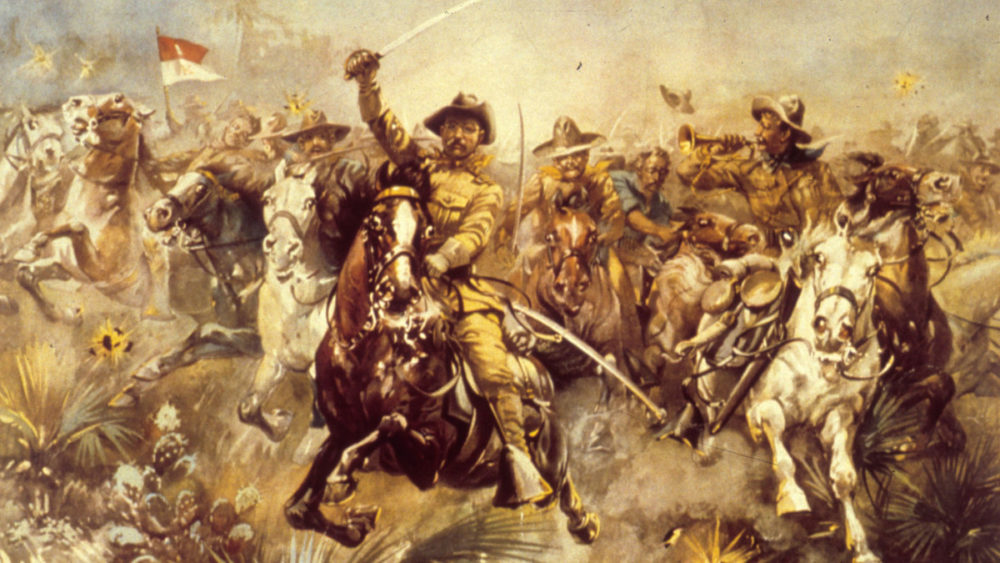
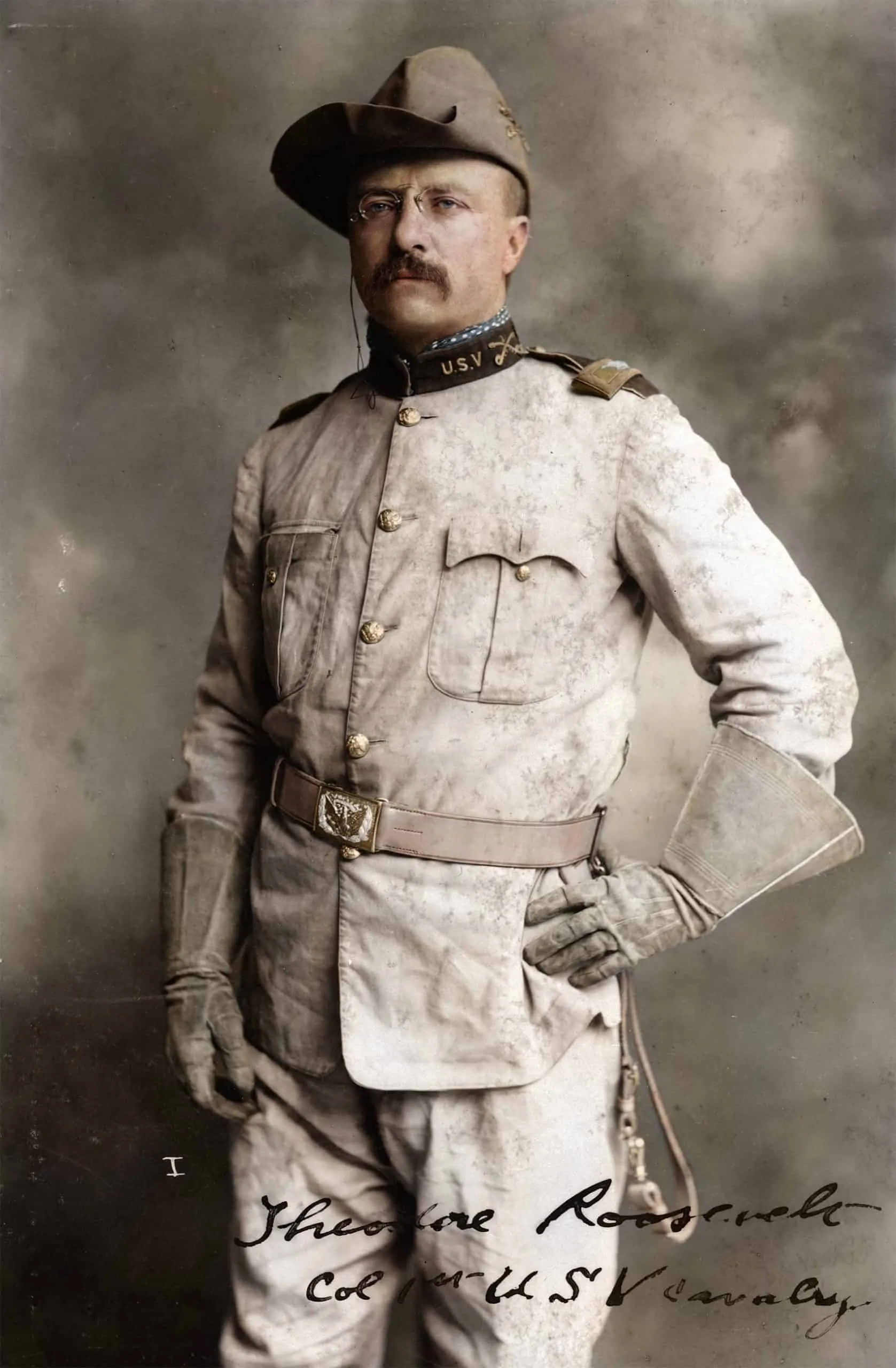
On June 3, 1898, 39 days into the Spanish American War, Theodore Roosevelt and his Rough Riders arrived in Florida by train, assigned to the U.S. transport Yucatan. But the departure date from Tampa Bay for Cuba kept changing. Just a month earlier, the 39-year-old TR had quit his job as assistant secretary of the Navy and along with Leonard Wood took command of the 1st Volunteer Cavalry Regiment.
TR wanted to fight Spaniards in Cuba. Roosevelt worried if the ship didn’t leave soon, his men’s livers weren’t going to withstand all the booze they were consuming. The first day was incredibly humid, with a hot, glassy atmosphere and scant wind. Anxious for war, TR was unperturbed by the omnipresent swarms of chiggers and sandflies.
While waiting to ship out, he studied the waterfowl along the wharf front. Some conservations believe his days in Tampa later influenced Roosevelt’s creation of federal bird sanctuaries along Florida’s coasts.
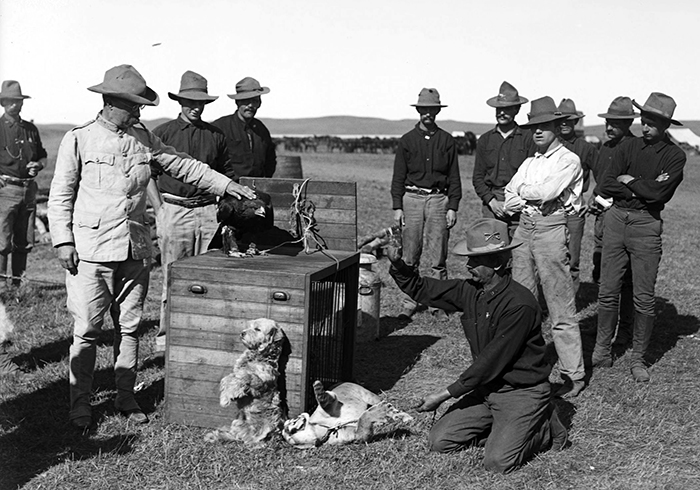
TR had the 1st Volunteer Cavalry Regiment add 3 animal mascots to their basic training The first was a young mountain lion, Josephine, given by trooper Charles Green of Arizona. Roosevelt wrote in his book “The Rough Riders” Josephine had an “infernal temper." Eventually Josephine would grow to weigh at least 90 pounds and be able to pull down a 750-pound elk with her jaws. The New York Times reported she was beloved by all the men. One time she got loose, climbed into bed with a soldier, and began playfully chewing on his toes. Roosevelt later chuckled in “The Rough Riders” that “he fled into the darkness with yells, much more unnerved than he would have been by the arrival of any number of Spaniards.”
Another steadfast comrade from the wild was a New Mexican golden eagle nicknamed “Teddy” in Colonel Roosevelt’s honor. Roosevelt loved to watch it swoop down and pluck a snake or other prey, and he even learned the art of falconry, wearing leather gloves and calling it back to camp after it had gone hunting. Roosevelt recalled when it was let loose it walked at will up and down the company streets and flew wherever he wished."
Josephine and Teddy had to be left behind in Tampa, but a dog named Cuba owned by Cpl. Cade C. Jackson of Troop A from Flagstaff, Arizona, accompanied the Rough Riders into battle throughout the campaign. Aboard the transport Yucatan, Roosevelt asked a Pawnee friend to draw the dog for his youngest daughter Ethel. TR said Cuba “ran everywhere around the ship and often howled when the band began to play.” The mascots added a compelling dimension to the press coverage of the Rough Riders. TR used the mascots to play to the cameras and they were part and parcel of his lifelong need to be associated with animals.
The Yucatan set sail on June 13 part of a convoy of 49 vessels that steamed south in three columns. When he first caught sight of the shoreline of Santiago Bay he wrote his sister Corinne that “All day we have steamed close to the Cuban Coast, high barren looking mountains rising abruptly from the shore, and at a distance looking much like those of Montana. We are well within the tropics, and at night the Southern Cross shows low above the Horizon; it seems strange to see it in the same sky with the Dipper.”
At both San Antonio and Tampa Bay, his two horses Rain-in-the-Face and Little Texas practically never left his side. With Vita graph motion picture technicians filming the Rough Riders wading ashore, a trooper was ordered to bring his horses safely onto the beach. A huge wave broke over Rain-in-the-Face. Unable to burst free from his harness, he inhaled seawater and drowned. For the only time during the war Roosevelt went berserk, “snorting like a bull,” as Albert Smith of Vita graph recalled, “split[ting in the air with one blasphemy after another.” As the other horses were brought ashore, Roosevelt kept shouting “Stop that god-damned animal torture!” every time saltwater got in a mare’s face.
On June 23 the Rough Riders debarked at the fishing village of Siboney about seven miles west of Daiquiri, behind Gen. Henry Ware Lawton’s 2nd Division and Gen. William Shafter’s 5th Corps. The soldiers took ashore blanket rolls, pup tents, mess kits, and weaponry, but no one thought to give them any insect repellent. There was no wind, and they felt on fire. The tangled jungles and chaparral of Cuba, particularly in early summer, were breeding grounds for flies that now swarmed the camps. Cuba also boasted 100 varieties of ants, including strange stinging ones that seemed to come from a different world. Unafraid of the soldiers, little crouching chameleons with coffin-shaped heads changed color from bright green to dark brown, depending on the foliage they rested on. “Here there are lots of funny little lizards that run about in the dusty roads very fast,” Roosevelt wrote to his daughter Ethel, “and then stand still with their heads up.”
Roosevelt’s letters were ablaze with the kind of martial detail found in Stephen Crane’s 1895 Civil War novel The Red Badge of Courage. Yet they’re also crowded with natural history, with observations about the “jungle-lined banks,” “great open woods of palms,” “mango trees,” “vultures wheeling overhead by hundreds,” and even a whole command “so weakened and shattered as to be ripe for dying like rotten sheep.” There was a strange confluence in Cuba between Roosevelt and the genius loci, as he constantly sought to conjure up nature as a way to increase his personal power.
Both in Roosevelt’s correspondence and his war memoir, the land crab is everywhere crawling out of the forests across roads and beaches to reach the water.
For the first time as an adult, Roosevelt was in the tropics. The very density of vegetation he encountered was daunting, the white herons often standing out against the greenery like tombstones. He now knew how Charles Darwin must have felt in the Galapagos and Tahiti.
After they stormed Santiago, many of his troops, a third of whom had served in the Civil War, lay wounded in ditches while flies buzzed around them.
Roosevelt wrote, “No man was allowed to drop out to help the wounded.”
“It was hard to leave them there in the jungle, where they might not be found again until the vultures and the land-crabs came, but war is a grim game and there was no choice.”
Ever since Roosevelt had discovered Darwin’s writings as a boy growing up in New York City, analyzing species and subspecies characteristics became a daily habit.
In his 1895 essay on “Social Evolution,” published in the North American Review, he offered a parable about when the dictates of natural selection superseded his love of wildlife. “
He wrote “even the most enthusiastic naturalist if attacked by a man-eating shark, would be much more interested in evading or repelling the attack than in determining the specific relations of the shark.”
July 1st, 1898 would come to be called his “crowded hour when on horseback he led the Rough Riders (plus elements of the 9th and 10th Regiments of regulars, African American “buffalo soldiers,” and other units) up Kettle Hill near San Juan Hill in the battle of San Juan Heights.

Once the escarpment was captured, TR now on foot, killed a Spaniard with a pistol that had been recovered from the sunken Maine. Roosevelt later said the charge surpassed all the other highlights of his life.
Somewhat creepily, it was reported, Roosevelt had beamed through the blood, mutilation, horror, and death, always flashing a wide grin as he blazed into the enemy. Whether he was ordering up artillery support, helping men cope with the prostrating heat, finding canned tomatoes to fuel the troops, encouraging Cuban insurgents, or miraculously procuring a huge bag of beans, he was always on top of the situation, doing whatever was humanly possible to help his men avoid both yellow fever and unnecessary enemy fire.
By the Fourth of July, Roosevelt had become a home-front legend, the most beloved hero produced in what the soon-to¬be secretary of state John Hay called “a splendid little war.” With the fall of San Juan Heights and the Spanish fleet destroyed, Santiago itself soon surrendered. The war was practically over. The stirring exploits of Colonel Roosevelt were published all over the United States, turning him overnight into the kind of epic leader he had always dreamed of being.
But the hardships Roosevelt had suffered were real. Supplies like eggs, meat, sugar, and jerky were nonexistent. Hardtack biscuits—the soldiers’ staple—had bred hideous little worms. Just to stay alive, the Rough Riders began frying mangoes. Worse still, the 100°F heat caused serious de hydration. Then there was the ghastly toll from tropical diseases. Diarrhea and dysentery struck the outfit. Fatigue became the norm. So many Rough Riders were dying from yellow fever and malaria that Roosevelt eventually asked the War Department to bring the regiment home to the Maine coast.

On August 14 the Rough Riders, following a brief stopover in Miami, arrived at Montauk Point and were placed in quarantine for six weeks.
TR was in the best shape of his life his face tanned, and his hair crew-cut, Roosevelt was living out his boyhood fantasy of being a war hero.
He had endured the trial of combat with grit and now it was all glory. Something in the American wilderness experience, Roosevelt believed, including his long stints of hunting in the Badlands and Bighorns in the 1880s, had given him an edge over the Spaniards.
The same with the Rough Riders, who hailed from the Southwest—Arizona, New Mexico, Oklahoma, and Indian Territory. Not a single Rough Rider got cold feet or shrank back.
Roosevelt believed that the American fighting spirit would only continue as long as outdoorsmen didn’t get lazy and rest on their laurels.
Slowly he was developing an underlying doctrine that he would call “the strenuous life.” The majestic open spaces of western America, such as the Red River Valley, the Guadalupe Mountains, the Black Mesa, the Sangre de Cristo Range, the Prescott Valley, and the Big Chino Wash, had hardened his men into self-reliance.
While the Rough Riders recuperated under yellow fever watch at Montauk, New York’s Republican Party was urging Roosevelt to run for governor that fall. As he contemplated his political future, everybody clamoring to shake his hand, he found respite watching the pervasive raccoons and white-tailed deer of Montauk. There was even Nantucket juneberry along the sandplains to study.
In August the New York Times ran a feature story about Josephine, reporting that the colonel might raise the big cat at Oyster Bay. But his wife, Edith, put a stop to that plan, and Josephine was carted off to tour the West as a circus attraction. Unfortunately, she got loose or was stolen in Chicago and was never seen again.
The eventual fate of Teddy the golden eagle was just as disappointing. Quite sensibly, Roosevelt had given him to the Central Park Zoo, where he became a popular tourist attraction, but he was killed by two bald eagles put into his cage to keep him company.
The body of the regiment’s mascot was shipped to Frank Chapman at the American Museum of Natural History to be stuffed.
The story of the dog Cuba had a happy ending. Discharged from quarantine, Corporal Jackson headed back to his home in Flagstaff and gave the celebrity terrier to Sam Black, a former Arizona Territory Ranger, where he lived with the family for 16 years in the lap of luxury. When Cuba died of natural causes, he was given a proper military funeral.
On August 20, 1898, Colonel Roosevelt was allowed to leave quarantine to return to his Oyster Bay home at Sagamore Hill for five days. By the time he got there, a groundswell of support had arisen for his gubernatorial candidacy.
All around Oyster Bay, he was greeted with shouts of “Teddy!” (which he hated) and “Welcome, Colonel!” (which he loved). “I would rather have led this regiment,” Roosevelt wrote a friend, “than be Governor of New York three times.”
Cleverly, Roosevelt had kept diaries in Cuba, jotting down exact dialogue and stream-of-consciousness impressions. His editor at Charles Scribner’s Sons, Robert Bridges, worried that if Roosevelt ran for governor the war memoir they’d been discussing would have to be put on hold. “Not at all,” Roosevelt assured him. “You shall have the various chapters in the time promised.”
Once back at Camp Wykoff, Roosevelt wandered Montauk Point, taking care of his golden eagle and taking little Cuba on walks. Roosevelt seemed like a changed man, he was calm. When reporters were around, he rode his horse up and down the beach.
By having “driven the Spaniard from the New World,” Roosevelt did what his father failed to do. During the Civil War his father was a $300 man actually paying $1,000 hiring a substitute to fight in his place. A decision his father said he always regretted.

On September 13 a bugle called, and the surviving Rough Riders dutifully fell into formation. In front of them was a card table with a blanket draped over a bulky object. The 1st Volunteer Cavalry had a parting gift for their courageous colonel. When the blanket was lifted it revealed an 1895 bronze sculpture by Frederic Remington, The Bronco Buster. (A cowboy was the western term for a cattle driver, while a bronco buster broke wild horses to the saddle.)
Tears welled up in Roosevelt’s eyes, his voice choked, and he stroked the steed’s mane as if it were real. “I would have been most deeply touched if the officers had given me this testimonial, but coming from you, my men, I appreciate it tenfold.”
Roosevelt said, The Rough Riders had found the best gift possible. It did a good job summing up TR as a fearless cowboy, stirrup flying free, determined to tame a wild stallion by putting the spurs to it, a quirt in his right hand, and the reins gripped in the other.

The 42 year old Roosevelt took more than just a Remington bronze to the White House in September 1901; his wilderness values and philosophy came with him, along with his saddle bag.
Besides continuing to collect myriad White House pets, Roosevelt used his executive power to save such national heirlooms as the Grand Canyon, Crater Lake, Devils Tower, Mesa Verde, and the Dry Tortugas.
On July 1, 1908, to help commemorate his “crowded hour” at Santiago, President Roosevelt created 45 new national forests scattered throughout 11 western states.
He also initiated many innovative protocols for range management, wildfire control, land planning, recreation, hydrology, and soil science throughout the American West. It was exactly a decade since his moment of military glory. His “crowded hour” 10 years later put much of the Rocky Mountains and the Pacific Northwest beyond the lumberman’s ax.
Adding to the conservationist theme, TR hired as forest rangers' men who had served with him in combat. These ex-Rough Riders now protected wild America from ruin under the banner of Roosevelt conservationism.
What particularly worried President Roosevelt at the dawn of the 20th century was that citizens of New York, Philadelphia, and Boston could not understand in the splendor of the American West. “To lose the chance to see frigate birds soaring in circles above the storm,” Roosevelt wrote, “or a file of pelicans winging their way homeward across the crimson afterglow of the sunset, or a myriad of terns flashing in the bright light of midday as they hover in the shifting maze above the beach—why the loss is like the loss of a gallery of masterpieces of the artists of old time.”

