
Roosevelts African Safari
TR proclaimed, “I want Uncle Sam to have a better African collection than anybody else.” Long before he was out of office TR decided to take a hunting trip through Africa. In his second term he took every chance he could to invite big game hunters to the White house to collect information and advice.
He brought four rifles. I have an "army Springfield .30 caliber, stocked and sighted to suit myself, a Winchester 405, a Fox No. 12 shotgun: no better gun was ever made and a double-barrel 500-450 Holland and Holland, a beautiful weapon presented to me by some English friends”
He brought 59 books everything from Poe to the Bible with Mark Twain thrown in as a chaser. Corrine had the copies trimmed, bound in pigskin and packed in a specially constructed oil cloth and aluminum case. Theodore Roosevelt’s “Pigskin Library” became front page news. Provisions included tomatoes, cans of Boston baked beans, California peaches and four tons of fine salt for curing skins.
”The Killer Lions of Tsavo” was a popular book published in 1907. It was written by famed British Big Game Hunter LT. Col. John Henry Paterson. In the book he retold of his killer lion adventures in Kenya.
Britain sent Paterson to Mombasa to oversee the construction of the British Kenya - Uganda Railroad that included building a bridge over the Tsavo River. While laying the tracks two lions began to attack the coolie workers (unidentified workers) in the middle of the night. They would attack and drag their victims into the jungle.
This continued for weeks until Paterson finally shot and killed the two lions who had been terrorizing the workers for weeks.
Theodore Roosevelt met with Paterson in the White House. When he went on Safari after leaving the presidency he would hunt and travel through what is now the Tsavo East National Park where the two lions stalked the workers.
By June 1908 TR began seeking sponsorship from the Smithsonian. Since the Museum’s African zoological and botanical collections were sorely limited the museum agreed. The Smithsonian also secured private donations with Andrew Carnegie becoming their largest contributor. TR had no problem covering his own expenses. Scribner’s originally offered $25,000 for a series of magazine articles, but before TR could say yes Collier’s upped the ante to $50,000 and McClure’s went as high as $60,000. To meet the competition Scribner’s raised their offer to $50,000 and TR accepted.
Many of Roosevelt’s friends pleaded with him to stay home. There were not only the risks from rhinos and lions the continent was being ravaged by deadly African sleeping sickness. Edith worried.
On Tuesday March 23rd, 1909, he and Kermit boarded the Hamburg in Hoboken and set sail for Africa. It was only three weeks after the leaving the White House. An enormous crowd gathered at the pier. A band played the Star-Spangled Banner. TR was wearing a military overcoat and an olive drab uniform bearing colonel’s board. He had received a lot of parting gifts, but his favorite was a small gold ruler with a concealed pencil given to him by President Taft. John L. Sullivan, the first heavyweight champion of gloved boxing, who Roosevelt met as governor, gave him a rabbit’s foot.
TR and Kermit sailed out of Hoboken on March 23, 1909, onboard the Hamburg surrounded by a flotilla of harbor ships decorated in America flags. Roosevelt stood on the deck saluting.
In Naples they transferred to another German ship, the Admiral where they crossed the Mediterranean, steamed through the Suez Canal to the Red Sea and onto Aden. They continued up the African coast to Mombasa arriving there on April 21st. The next day TR sat perched on a seat built across a locomotive cowcatcher. He wrote it was “paradise for a naturalist.” It was an additional 300 miles inland from Mombasa where Roosevelt said, “The Great Adventure really began.”

The safari moved eastward hunting as they went. TR had specified, “no animals would be shot except those needed for museum specimens or food.” By June 1st they reached Nairobi where the first of the specimens were shipped to the states. It’s also where TR sent Scribner’s the first of his 14 articles. He covered everything from dangerous encounters with big game to his joy in seeing brightly colored birds, insects and flowers. Each night, regardless of how tired, he sat at his travel desk recording the day’s events wearing netting and gauntlets to protect him from the mosquitoes. Kermit wrote his father was invariably good-humored about it saying it was the price he was paying for having fun.
The safari moved from Nairobi deeper into the interior. By Christmas they had reached Lake Victoria and pressed on to Albert Nyanza arriving there January 5th, 1910. The remaining two months were spent in pursuit of the rare, huge square mouthed “white” rhino. (The Rhino Sculpture in the hall is a Black Rhino). They then continued northward on the Nile reaching Khartoum on March 14th where the expedition was disbanded. Waiting for them in Khartoum were Edith and Ethel.
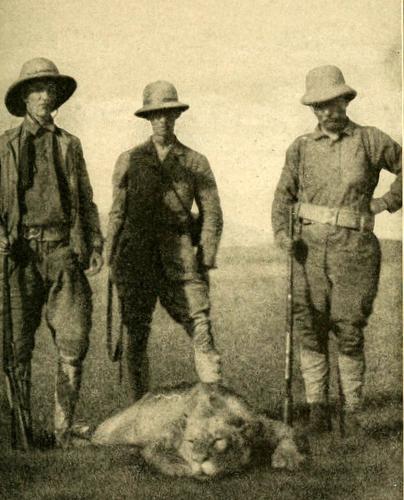
By the time it was over Roosevelt enriched the National Museum with over 11,000 specimens; nearly 5,000 mammals, 4,000 birds, 500 fish and 2,000 reptiles. He brought back thousands of insects, shells and plants declaring that many of the species were new to science. He personally brought home 296 specimens including 9 lions, 8 elephants, 13 rhinos and 6 buffaloes. Kermit returned with 216.
That fall TR’s articles were published in a book, “African Game Tails” An Account of the African Wanderings of an American Hunter-Naturalist. It was dedicated to Kermit and became an instant best-seller. The National Geographic called it a “contribution to science, geography, literature and adventure.” It’s still regarded as a hunting classic.

TR and Kermit sailed out of Hoboken on March 23, 1909, onboard the Hamburg surrounded by a flotilla of harbor ships decorated in America flags. Roosevelt stood on the deck saluting.
In Naples they transferred to another German ship, the Admiral where they crossed the Mediterranean, steamed through the Suez Canal to the Red Sea and onto Aden. They continued up the African coast to Mombasa arriving there on April 21st. The next day TR sat perched on a seat built across a locomotive cowcatcher. He wrote it was “paradise for a naturalist.” It was an additional 300 miles inland from Mombasa where Roosevelt said, “The Great Adventure really began.”
The safari moved eastward hunting as they went. Roosevelt had specified, “no animals would be shot except those needed for museum specimens or food.” By June 1st they reached Nairobi where the first of the specimens were shipped to the states. It’s also where TR sent Scribner’s the first of his 14 articles. He covered everything from dangerous encounters with big game to his joy in seeing brightly colored birds, insects and flowers. Each night, regardless of how tired, he sat at his travel desk recording the day’s events wearing netting and gauntlets to protect him from the mosquitoes. Kermit wrote his father was invariably good-humored about it saying it was the price he was paying for having fun.