
Matthew Stanley Quay

Quay was known as the Napoleon of Politics. He was a brilliant Pennsylvania Senator and a National powerhouse. Roosevelt considered Quay a scholar. The two corresponded discussing Italian poetry.
Rudyard Kipling was sent to the U.S. to write a story on the legendary political boss. When the two met Quay showed Kipling his extensive personal library.
That afternoon the two talked literature. Kipling wrote back to his editor that he hadn’t found a legendary U.S. boss. What he found in Matthew Quay was someone he considered to be the greatest living man of letters.
Quay was well read and skilled in the rough and tumble world of hard nose politics. When Grover Cleveland defeated James Blane he believed the loss was due to Democratic voter fraud in New York City. If Cleveland didn’t take New York’s 36 electoral votes he would have lost. When the smoke cleared Cleveland carried the state by a little over 1,000 votes.
Vowing that would never happen again Quay spent $100,000 collecting all the names of voters in New York City. He then told Democratic Headquarters if they ever tried to pull another voting stunt they'd have to build more jails to make room for everyone he was going to put behind bars.
When it came to Governor Roosevelt, Quay knew what was happening behind the scenes. Quay knew Roosevelt ultimately had his eye on the presidency and saw no future staying in Albany. Platt wanted Roosevelt out but didn't have the where with all to get past Hannah. Quay hated Hannah and agreed to help, even for nothing more than the enjoyment of being a thorn in Hannah’s side.
His strategy was simple. He’d go after the southern delegates who made up about 25% of the total delegation. (Roosevelt learns of the importance of the black southern delegation as used by McKinley in 1896 and Quay in 1900). While black southern delegates were an influential voting block at the convention; they had difficulty in the Jim Crow south delivering votes in the general election. Quay argued the party was getting the short end of the stick. If they couldn’t deliver state votes it was only fair that the party should look to reduce their financial support to more accurately represent their level of contribution.
The delegates went crazy. Quay then told them he wouldn’t propose any changes if the southern delegates all agreed to nominate Roosevelt for Vice President. It was unanimous. The south was in it for Roosevelt. The panic now switched from the southern delegates to Mark Hannah. He began to hear the TR express train rumbling down the tracks picking up an unstoppable head of steam.
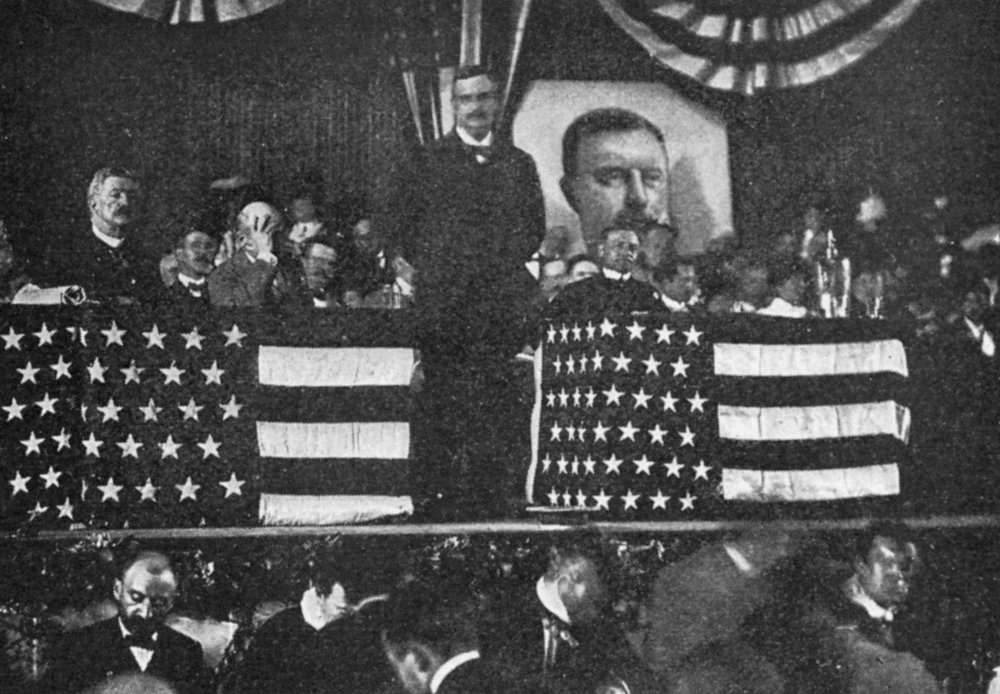
It didn’t take long before everyone was jumping on the Roosevelt band wagon. Hannah thought the delegates had gone crazy. Who would ever want Roosevelt a heartbeat away from the presidency? It was too late. June 21st Roosevelt was nominated on the first ballot. The only one who didn’t vote for Roosevelt was Roosevelt. This was at a time when the man didn’t seek the office. The office sought the man and T.R. played it perfectly.
If Roosevelt believed Quay worked hand in hand with Thomas Platt and the rest of the New York GOP bosses to push him out of New York with the purpose of ending his political ambitions, Roosevelt would never have talked to Quay ever again.
Roosevelt was a man, who knew how to hold a grudge. The children’s author William J. Long, wrote a series of books featuring a rabbit that he named Peter. Roosevelt disliked Long’s books because he gave animals human characteristics. Roosevelt felt that misrepresented their actual behavior to gullible young readers. While in the White House Roosevelt wanted all of Long’s books removed from children’s libraries. Long invited Roosevelt to his house in Stamford, Connecticut in an effort to “settle things like men.” Roosevelt ignored the author’s invitation.
In the summer of 1903 Quay was in failing health. A year later he was seriously ill. He sent word to Roosevelt he had something to say to T.R and while he couldn’t walk on his own, he could arrange to be carried to the White House.
Roosevelt told Quay to stay home and that he’d call on him on his way back from church. When Roosevelt arrived, Quay thanked him for coming and told him he was about to leave Washington for the last time. He was sure death was not far off. He wanted to see the President to get his personal promise that he’d look after the interests of the Delaware Indians.
Quay was proud that his great-great-grandmother was a Delaware. T.R. said anytime the Indians came to Washington they always wanted to see Quay. He was their friend. The President assured Quay he would personally see to it that no injustice was done to the Delaware. Roosevelt’s assurances to Quay were an act of pure friendship. If Roosevelt knew Quay had sided with Platt to end his career in 1900 by maneuvering him into the vice presidency against his will he’d never have gone to see Quay.
After his death Roosevelt said Quay was a kind man whose deeds were not publicized. Many of them became known only after his death.

