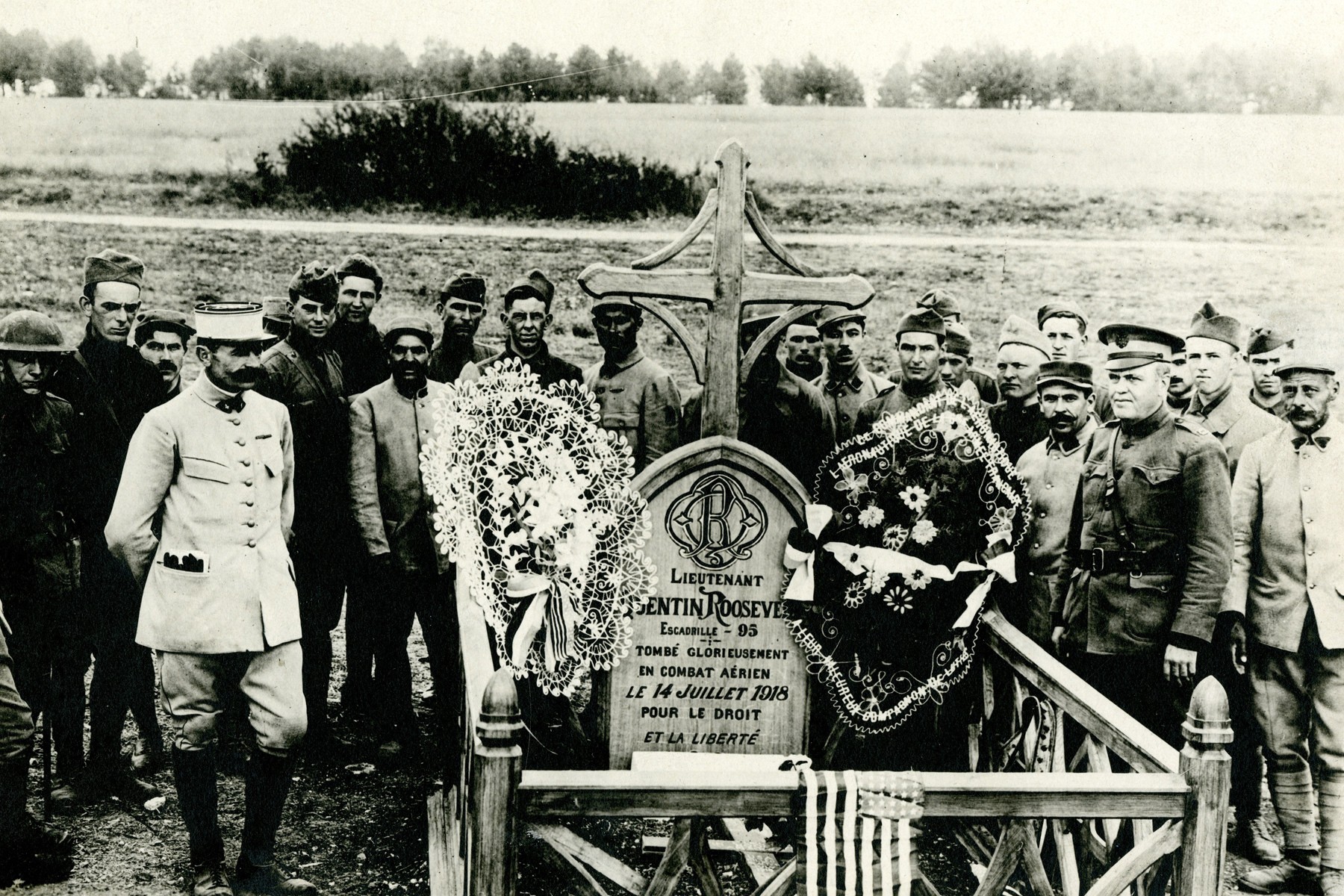
Quentin Shot Down Over France in WWI
The 2nd Battle of the Marne
Quentin was born November 19, 1897 a couple of months before TR shipped off to Cuba. He was the ring leader of the “White House Gang” who threw spitballs on Jackson’s portrait and snowballs at the Secret Service. TR gave him the nickname "Quinikins.”
He went to Peter Force Elementary School in Washington and then attended Groton in Massachusetts.
He was an excellent student and was admitted to Harvard in 1915. He fell in love with Flora Whitney and after turning 19 the two became engaged. The outbreak of the war prevented their marriage.
Quentin dropped out of Harvard In May 1917 a month after Wilson declared war. All of Roosevelt’s sons were enlisting and Ethel had joined up with the Red Cross. TR helped Quentin get into the United States Army Air Service and began training in Mineola at Hazelhurst Field.

He had bad eyesight and a bad back. Out in Arizona with his father in 1913 a pack mule rolled over his back leaving him with chronic pain. After shipping off to France he spent his first three months on supply duty and then in flight training before becoming a pilot in the 95th Aero Squadron, the famous Kicking Mules. They were part of the 1st Pursuit Group based in Saint-Cloud, France.

Quentin only flew two full combat missions. On July 5th 1918 he took off for the first time, but had to return due to engine failure. He went up a second time, but after two shots his Vickers machine gun jammed. On July 9th it’s believed he got his first kill. He had flown into a cloud and gotten separated from his squadron. Thinking he was rejoining their formation he discovered he was following three German planes back across enemy lines into Germany. He had gone unnoticed and was lucky enough to pick off a Fokker D7 before managing to escape. Five days later on July 14th Bastille Day, Quentin was caught out of formation. German Ace Sgt. Karl Thom with 27 victories is credited with ending Quentin's life. He had gotten so close he was able to plant two machine gun bullets in the back of his head. He was dead before he hit the ground.
The Nieuport 27 he was flying didn’t catch fire. German troops pulled his body from the wreckage and laid it next to the fuselage. Within a half hour a photographer appeared to take photographs. One became a postcard that made its way to Sagamore Hill. The German’s buried Quentin where he crashed in Coulonges-Cohan, France. 37 years later in 1955 he was moved to Normandy where he now rests next to his eldest brother Theodore Roosevelt Jr. He is currently the only child of a U.S. President to die in combat. He was awarded the Purple Heart and the French Croix de Guerre. In 1919, the year Quentin would have graduated from Harvard, the school posthumously granted him his degree.

Malady of the
In 1915, shortly after WWI starts in Europe and two years before America went “Over There” Roosevelt begins his campaign of preparedness. He urged America to build a bigger Navy and a stronger Army. He was sure the country would eventually go to war. TR was joined by his friends Leonard Wood and Elihu Root.
At the time the country’s standing army was about 100,000 men along with another 110,000 National Guard troops all poorly trained and poorly equipped with outdated rifles. There was no modern artillery, no machine guns and not a single plane worthy of combat. Roosevelt’s call to action fell on deaf ears.
To the public Roosevelt didn’t provide any answers and he seemed irresponsible in urging America to go headlong into war rather than seeing war as a last resort. At its worst some believed Roosevelt wanted to go to war to fulfill his own personal crusade. He was out of step with the country and he was playing a dangerous game with his family.
Unlike Europe, America preferred a small civilian army as outlined in the Constitution. The country felt safe protected by the Atlantic and the Pacific. It’s the reason Roosevelt as president could build a Navy, but couldn’t build an Army.
To TR the country’s lack of readiness didn’t seem to bother him when it came to his sons. He wanted them at the front and wasn’t going to let unpreparedness keep them from seeing the elephant up close.
Roosevelt wrote Quentin, “All of you children have by your deeds justified my words.” TR loved reading Quentin’s letters about his risk-taking, about his acrobatics by moonlight. Quentin said it was now our job to “practice what father preached.”
Despite suffering from periods of air sickness, poor eyesight and a bad back Quentin undertook the riskiest assignment in the war. He joined the Army’s Air Service. Newly trained combat pilots called themselves the "20-Minute Club" because the life expectancy of a new pilot in combat was about 20 minutes. The British reported the average life expectancy for their new pilots was 11 days.
In his unit it was believed Quentin suffered from what they called, “a malady of the soul.” He seemed to be battling demons and it was believed there were hints of a death wish.
News Reaches Sagamore Hill
It was Wednesday morning July 17th when Phil Thompson, an AP reporter and friend of Roosevelt’s arrived at the front door to Sagamore Hill.
TR believed he was going to receive information on Quentin. The last report was he hadn’t returned from his combat mission of the 14th. The two entered the library and TR closed the pocket door behind them. Tears were in Thompson’s eyes as he told Roosevelt his son Quentin had died in aerial combat.
TR was standing beneath the portrait of his father when he received the news. The two would then pace the piazza for about a half hour before Thompson left TR alone to tell Edith they had lost their youngest son.
Together they publicly held firm to their belief it was better Quentin went to war, to do his part, rather than to have stayed home and worked in an office behind the safety of a desk. Edith told the press she had raised her children to become eagles, not sparrows. Roosevelt bragged that Quentin had smashed his plane “beautifully” in a solo battle surrounded by multiple German fighters.
It was a different story privately. Those who worked at Sagamore Hill saw TR weeping during his solitary walks around the property. There were times he could be found in the stable with his arms draped around the neck of Quentin’s horse murmuring under his breath, “Quinikins, poor Quinikins.”
Roosevelt wrote, “To feel that one has inspired a boy to conduct that has resulted in his death has a very serious side for a father.”
TR never fully recovered. It was not only his sons; he was encouraging the sons of an entire nation to go to war knowing full well America was ill prepared. It was as if his entire world was caving in. He aged quickly. This wasn’t the gallant charge up the San Juan Heights, this was mechanized murder. 176 days after Quentin’s death in combat over France, Theodore Roosevelt died in his sleep at Sagamore Hill.