
Writings - The Early Years
TR was just 19 when he published his first book, The Summer Birds of the Adirondacks in Franklin County. It gained him early notoriety. His Naval War of 1812 was published when he was 23. TR started writing the book when he was an undergraduate at Harvard. It was published in 1882 and was so popular three editions were printed in the first year.
Encouraged by his success he began to seriously consider launching a 2nd career as a historian - writer. To Roosevelt it didn’t matter much that he’d only taken one course in history at Harvard. He was going to follow in the footsteps of amateur historians like George Bancroft and Francis Parkman. He dedicated the Winning of the West to Parkman. It was a tradition that was quickly passing to make room for more professional, academically qualified historians.
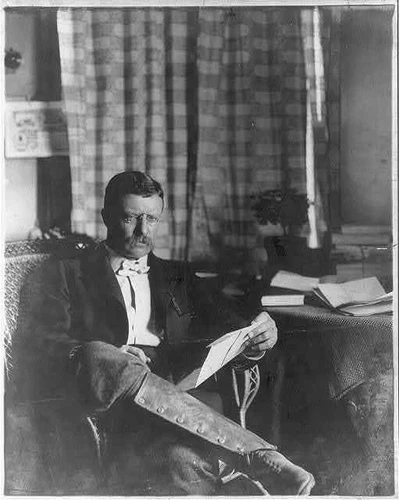
In the 10 years after The Naval War of 1812, he published; 3 biographies, a History of New York, a book of Hero Tails edited with Henry Cabot Lodge and what he called his Magnus Opus, the 6 volume Winning of the West which he wrote from 1889 to 1895. The west he wrote about was not the wild west that typically comes to mind. This was the original west that spanned from the Allegheny’s to the Mississippi. It was the west of the 18th century.
There is a lot to learn about Roosevelt from his own writing. Much more than can be learned in the pages of biographers.
After his deeply researched Naval War of 1812 that TR admitted was as dry as reading the dictionary, he takes a different approach and writes his biography of Thomas Hart Benton in 5 months while cow punching in the Bad Lands.
After getting his commission to write about Benton he confessed to Henry Cabot Lodge he knew very little about the Missouri Senator in the years after he left Washington. He told Lodge he had to evolve Benton’s character from his own inner consciousness. He added he “preferred having some foundation of fact no matter how slender on which to build the super structure of his arabesque fancy especially since he was writing a history.”
The result of his final efforts on Benton and Governor Morris become more of a personal platform.